

Two Ways In
Click Create Workflow in the notebook panel, or ask Orion in chat. Both call the same thing underneath, so pick whichever is faster in the moment. Asking is quickest when you already know what you want. In the chat where the analysis ran: “save this as a workflow that runs every Monday at 8am and outputs a dashboard.” It also handles schedules the dialog cannot express, like running at several specific times a day. The dialog is the guided version. Open the notebook panel in Chat. At the top you will find Save as a Workflow. Click Create Workflow.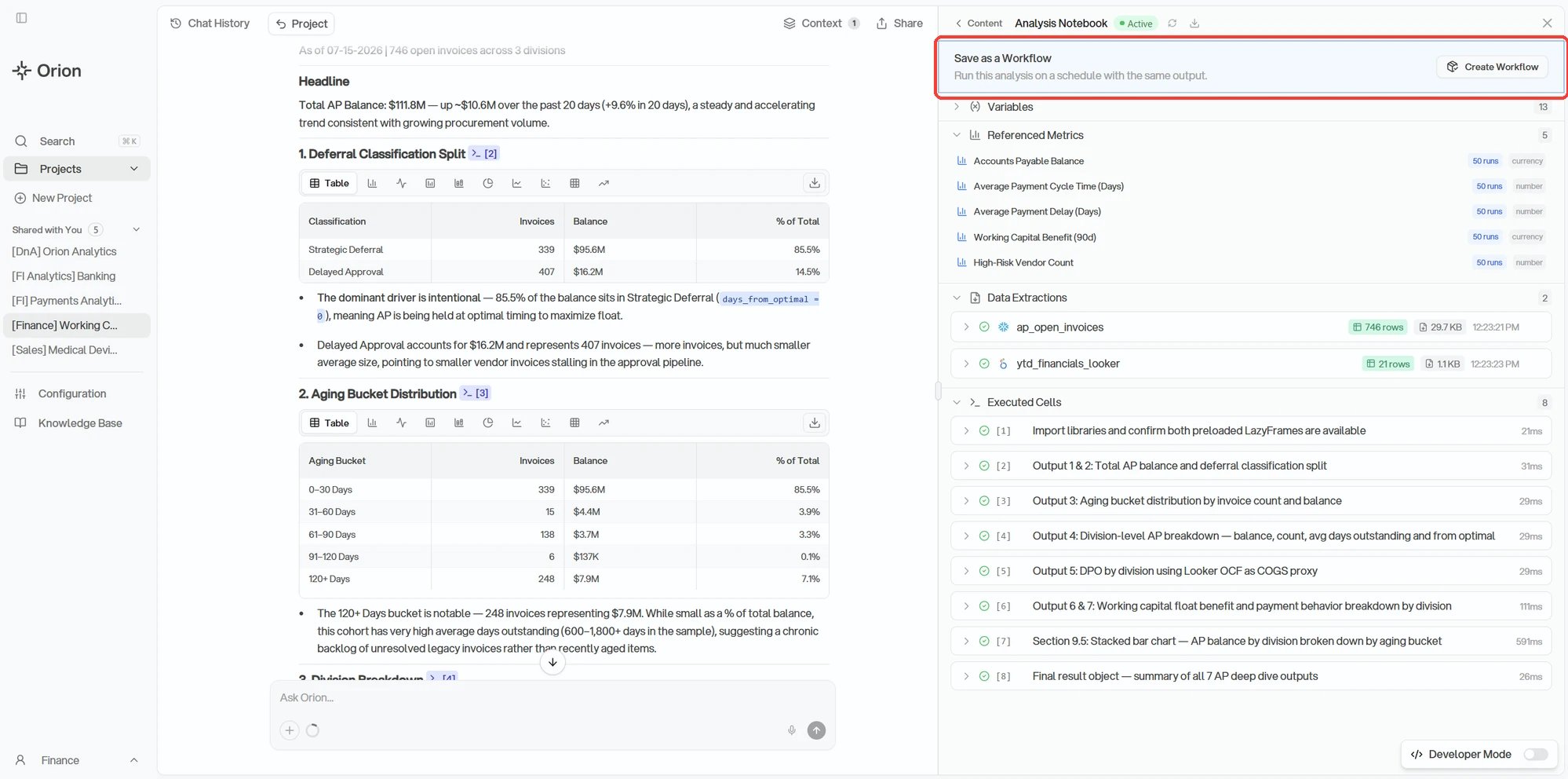
Create a Workflow from the notebook panel
The Dialog
It asks for three things.1
When it should run
Pick Hour, Day, Week, or Month. Week adds a day picker, Month adds a day of
the month, and Hour asks only for the minute it should fire on. Your local
timezone is preselected.
2
What it should output
Choose Markdown Report, Slide Deck, or Dashboard. This is the
format the Workflow starts with, not a permanent choice. See Outputs and
Delivery.
3
When to notify you
Describe in plain language what makes a run worth an email, for example
“only notify me if revenue changes by more than 10%”. Leave it blank to
decide later.
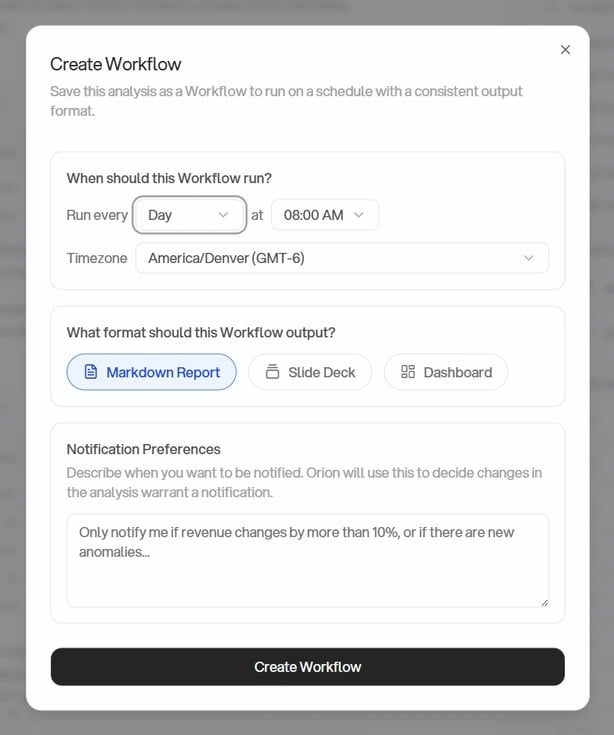
Configure a new Workflow
What Orion Builds
Submitting the dialog writes exactly the kind of request you would have typed and sends it to Orion, which is why the two routes behave the same. From there Orion assembles the recipe. Only cells that ran cleanly make it in, so anything that errored is left behind. It then does a full dry run end to end before saving. If that dry run fails nothing is saved and Orion tells you what broke, which is the point: a Workflow that cannot complete once will not complete on a schedule either.The Evergreen Check
A Workflow that hardcodes last quarter’s dates would keep reporting last quarter forever, so Orion reviews the analysis for that before saving. You do not have to ask. The check looks for hardcoded dates and date ranges, filter values and IDs that came from your specific session, and hardcoded file paths, and rewrites them to relative equivalents: a fixed2026-01-01 cutoff becomes a rolling window.
Writing the analysis that way from the start is still cheaper than having it corrected. See Use Relative Dates.
Next Steps
Outputs and Delivery
Choose formats, set a publish URL, and decide who gets emailed
Manage Workflows
Schedules, run history, and editing what you built