

Formats
Markdown Report
A written report. Best for narrative findings someone will read top to
bottom.
Dashboard
A styled web page of charts and tables. Best for numbers people check at a
glance.
Slide Deck
A presentation. Best for recurring meetings where the analysis gets
presented rather than read.
Podcast
An audio briefing of the same analysis. Best for people who will listen on
the way to work but never open the deck.
Data Exports
An export is data rather than narrative. Where a report interprets the numbers, an export hands over the rows. An export step points at a DataFrame your notebook produced, by variable name, and writes it out under a filename you choose. Each export gets its own publish URL, and can be attached to a notification alongside the reports, so the same email can carry the narrative and the raw data behind it. Reach for one when the recipient is going to do their own work with the numbers: a finance team that wants the line items in a spreadsheet, or a downstream process that reads the file on a schedule.Report Configuration
Opening an output step gives you its Report Configuration, which controls how the result is written and where it lands.- Report Style: formatting, structure, length, tone, and emphasis, in plain language. This is the main lever for what the output reads like. “Executive summary, one page max” and “five slides for a board meeting” both belong here.
- Publish URL: the address the result is published at,
/share/plus a slug you choose. Set it to something recognizable likeweekly-revenue. - Report Visibility: who inside the project can view the result.
- Context Sources: the notebooks behind the report, plus any Context pages you attach as ground truth.
Templates
Report Style controls how the writing reads. A template controls how a slide deck looks. Attach one and every run comes back in the same layout and theming, which matters once the same deck goes to the same meeting every week and people navigate it from memory. Templates are optional and are saved per project. Set one from Artifact Template in an output step’s Report Configuration. You get them two ways: upload an HTML file, or generate a deck you like in chat and use Save as template to keep it.Notifications
When a run finishes, a Workflow can email the result out. Open the Notification step to control what gets sent and who gets it:- Message: the body of the email that goes out, which you write yourself.
- Artifacts: which of the Workflow’s outputs and exports get attached. Each report and export is a checkbox, so a Workflow that produces three things can send all three or just one.
- Recipients: who receives it, chosen as Users, Groups, or Emails. Users covers people already on the project, searchable by name or email, and Groups covers the project’s groups. Emails takes any address you type, which is how you reach someone outside the project.
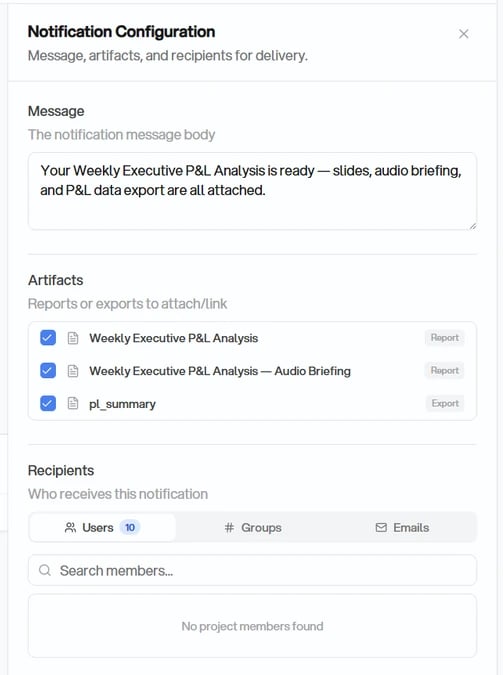
Configure a Workflow notification
Notification Preference
Recipients control who gets email. A notification preference controls when. Write it in plain language when you create the Workflow and Orion turns it into a condition evaluated on each run:- “Only notify me when there is a significant change”
- “Only if churn goes above 5% or a new anomaly shows up”
- “Always notify me”
Delivery is email only. Workflows do not post to Slack, Teams, or SMS. For a
broader summary of a project’s activity, see Email
digest.